
Blog

HOA & property management insights

Practical guidance for boards, managers, and community operators evaluating modern HOA software.

Florida SIRS Deadline: What HOA Boards Must Do By December 31, 2026
Florida HOACompliance

Florida SIRS Deadline: What Boards Must Do By December 31, 2026

Most Florida condo boards remember December 31, 2025 as "the SIRS deadline." For a large group of associations, though, that wasn't the real deadline. HB 913 (2025) let associations that also owed a milestone inspection do both at once, and gave them until December 31, 2026. That year-end date is now about 12 weeks away, and the statute says plainly that it won't move: "In no event may the structural integrity reserve study be completed after December 31, 2026." The 2026 legislative session didn't change it either. The omnibus condo bill (HB 657) died in the Senate in March, so the rules boards are working under still come from HB 1021 (2024) and HB 913 (2025).

MyFrontYard · October 6, 2026

Colorado's New 30 Year Reserve Study Mandate: HB26-1099
Colorado HOACompliance

Colorado's New 30-Year Reserve Study Mandate: What HB26-1099 Requires

Reserve funding is the line item that keeps Colorado boards up at night. Underfund it and the roof, the paving, or the pool eventually turns into a special assessment. Owners are rarely ready for that. Much of the problem starts on day one. A developer sets the first budget while it still controls the HOA. That budget is often built to keep monthly dues low and sell units, not to pay for a roof 20 years out. By the time owners take over the board, the gap is already there. HB26-1099, titled Protect Financial Condition of Homeowners Associations, goes after that gap. Governor Polis signed it on April 13, 2026, and it took effect August 12, 2026. Here's what it requires, who it applies to, and what it doesn't do.

MyFrontYard · October 5, 2026

Florida's HB 1203
Florida HOACompliance

HB 1203 Explained: Criminal Liability for Records Mismanagement

Most coverage of Florida's 2024 HOA reform law opens with fines, architectural review, and garbage cans. Those changes are real, but they bury the part that changed the stakes for board members: HB 1203 made certain records failures a crime. Before July 1, 2024, a Florida HOA that stonewalled a records request mostly risked a civil damages claim and attorney's fees. Under HB 1203 (Chapter 2024-221, Laws of Florida), a director or community association manager can now face a criminal charge for the same conduct, provided the statute's intent elements are met. This article walks through each new offense, what it actually takes to trigger one, and what your board should be doing about it.

MyFrontYard · October 1, 2026

Minnesota Rule for Bids Greater Than $50,000
Minnesota HOA

Minnesota HOA Boards: The New Competitive-Bidding Rule for $50,000+ Projects

Governor Tim Walz signed Minnesota's HOA reform package, HF 1268 / SF 1750 (2026 Minn. Laws ch. 82), on May 12, 2026. Most coverage has focused on the owner-facing pieces: caps on fines, interest, and late fees. But one of the provisions that changes how boards actually operate is a new competitive-bidding rule for contracts over $50,000, added to the board-powers section of the Common Interest Ownership Act, Minn. Stat. § 515B.3-103.

MyFrontYard · September 29, 2026

California's Davis Sterling Act
California HOA

California HOA Records Requests: The Davis-Stirling Act Explained

If you own a home in a California HOA or condominium, you have one of the strongest statutory rights to see association records of any state in the country. The Davis-Stirling Common Interest Development Act spells out exactly which records an owner can see, how fast the association has to produce them, what it can charge, what it can hold back, and what happens when it doesn't comply.

My Front Yard · September 25, 2026

Georgia Bill of Rights
Georgia HOA

Georgia's Property Owners' Bill of Rights Act: What SB 406 Requires

Georgia Governor Brian Kemp signed (Senate Bill 406), the Georgia Property Owners' Bill of Rights Act, into law on May 12, 2026. Lawyers who track community-association law are calling it the most significant change to Georgia HOA law in decades, and it isn't a narrow fix. SB 406 touches registration, recordkeeping, payment processing, attorney's fees, foreclosure, and dispute resolution, and it applies broadly to nongovernmental residential property owner associations, including HOAs, condominium associations, cooperatives, and other common-interest communities.

MYFrontYard · September 24, 2026

Statutory Digest
Virginia HOA

Virginia’s New Nonstock Corporation Act: Why Your Declaration Now Outranks Your Bylaws

Most Virginia HOAs and condominium associations are incorporated as nonstock corporations. That means they answer to two sets of rules: the community-association statutes (the Property Owners’ Association Act or the Condominium Act) and the Virginia Nonstock Corporation Act, which governs how the corporation itself runs. In 2026 the General Assembly rewrote that corporate statute. **SB 246 and HB 439**, passed unanimously and approved by the Governor in April 2026, make dozens of changes to the Act. They take effect January 1, 2027. Most of the bill is corporate housekeeping. One part matters directly to community associations. When your **declaration** (or condominium instruments) and your **articles of incorporation or bylaws** disagree about dues, assessments, fees, or membership, the declaration now wins. Here’s why that rule was needed, what it covers, and what it doesn’t.

MyFrontYard · September 23, 2026

Which States Actually Regulate HOAs? A 5-State Comparison
Compliance

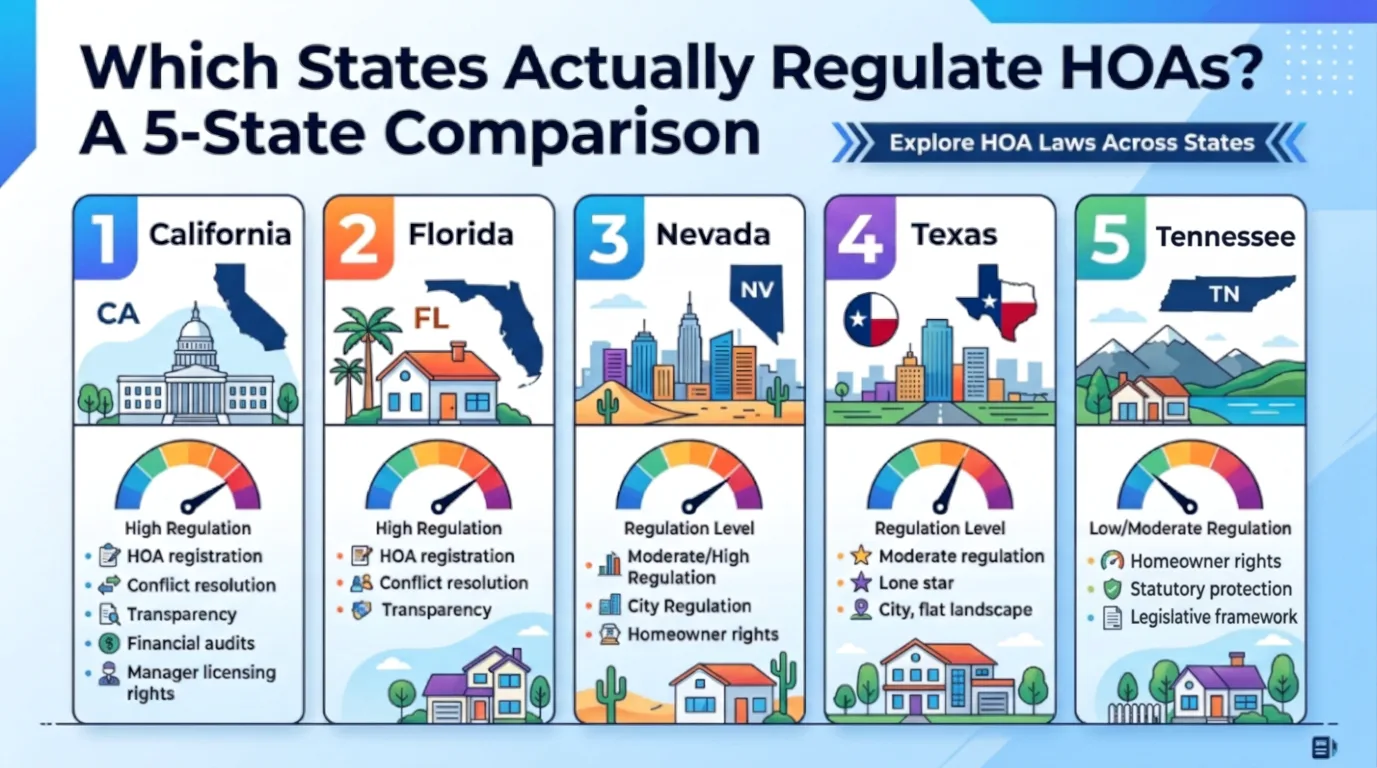
Which States Actually Regulate HOA's? A 5-State Comparison

Most homeowners assume that somewhere in state government, there's an office that oversees HOAs the way a banking regulator oversees banks, or a licensing board oversees contractors. Across Florida, Texas, Nevada, California, and Tennessee, that assumption is mostly wrong — and the exceptions are more interesting than the rule. Of these five states, only one has an agency that can investigate a board and discipline it. One more has a regulator, but its authority stops at the condominium property line. The other three route essentially everything through civil court, with no government office to call first.

MyFrontYard · September 22, 2026

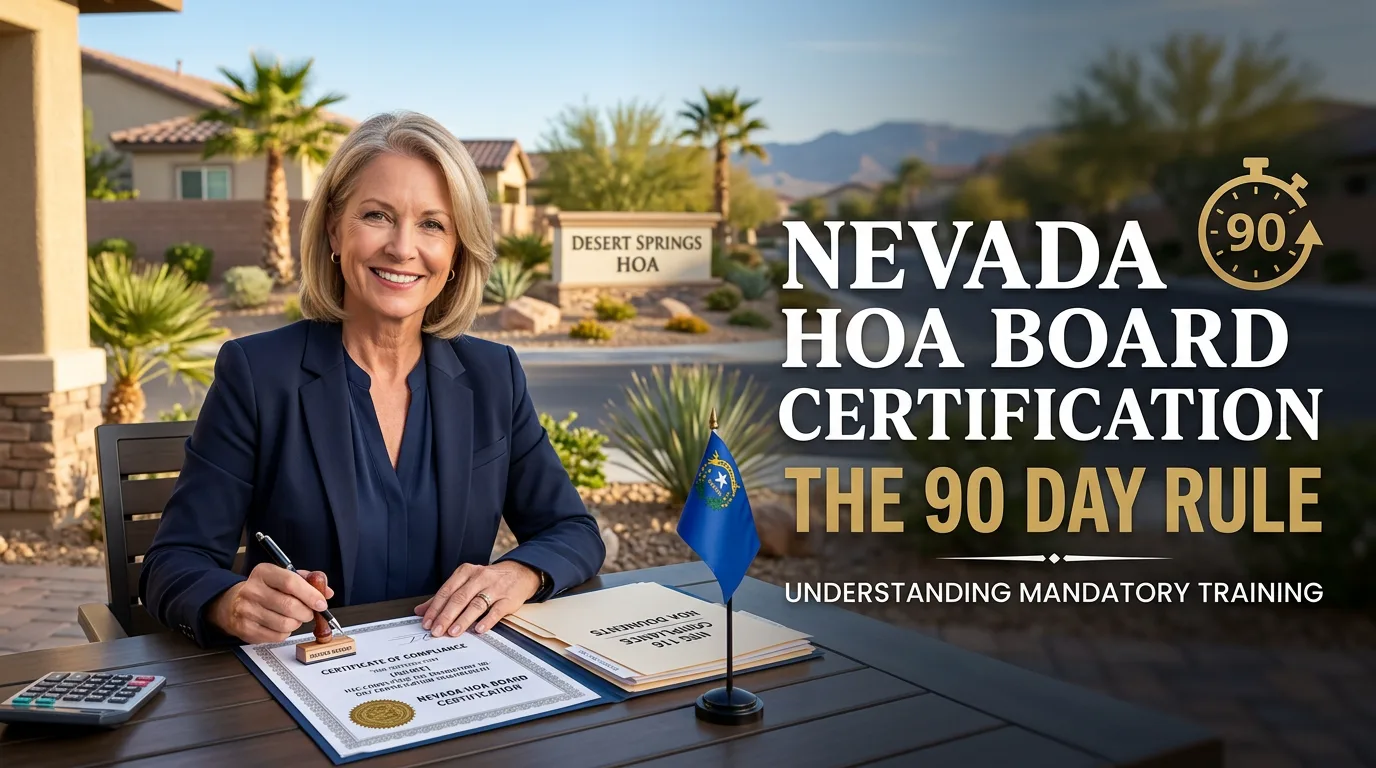
Nevada HOA Board Certification: The 90 Day Rule
Nevada HOA

Nevada HOA Board Certification: The 90-Day Rule New HOA Directors Miss

You just won a seat on your HOA's executive board. Congratulations — you now have a clock running. Nevada law gives every newly elected or appointed board member exactly **90 days** to file a written certification with the association confirming that they've read and understand the community's governing documents and the relevant provisions of NRS 116. Miss the deadline, and Nevada's Real Estate Division has the authority to treat it as a compliance violation against the association, not just an oversight by one director. Most new board members have never heard of this requirement until it's almost too late. Here's what it actually says, who it applies to, and how to stay on the right side of it.

MyFrontYard · September 18, 2026

Page 1 of 2Next